How is gym software usually priced?
Almost every offer you will see is built from four models, often combined. Knowing which one you are looking at tells you how the bill will grow with your gym.
- A flat monthly fee: the same amount whatever your size. Simple to budget, but check what is left out of it.
- A price per active member, often in bands: the bill rises as you grow, which can feel like a tax on success. Ask what counts as active: frozen memberships, trials and lapsed members are counted differently by different providers.
- A price per site: each new location adds a full fee, even if it shares staff and members with the first one.
- Tiers and modules: a basic plan for bookings, and extra charges for payments, a member app, marketing tools, reports or access control.
What costs are not on the pricing page?
The monthly figure is rarely the whole cost. These are the items that tend to appear after signing, so ask about each one in writing before you commit.
- Setup and onboarding fees, and a separate charge to import your members from your current system
- Payment fees: a percentage per card transaction, a fixed fee per collection, or both, on top of what your bank charges
- Text message and email credits for reminders and marketing
- A member app with your gym's name, often sold as an extra with its own setup fee
- Hardware for check-in: turnstiles, door readers, tablets at reception
- Contract length, notice period and price rises at renewal
Free trial, free plan and free software: what is the difference?
They sound alike and are three different things. A free trial is the full product for a few weeks: useful for testing, but the price arrives when the trial ends and your members are already in.
A free plan is permanent but capped: a limit on members, classes or features, set so that a growing gym has to upgrade. Check where the cap sits compared with your size today and in a year.
Free software gives everyone everything, with no cap and no subscription. It can be sustainable, but only if someone else pays: ask the provider exactly who, and how. A free product that cannot explain its business model is a risk to your data and your members.
What must gym software do, whatever it costs?
Before comparing prices, make sure you are comparing the same thing. For most gyms and studios, these are the basics, and a cheap tool that misses one of them costs you in staff time. The full checklist is in how to choose gym management software.
- A class timetable with spots per class, and a waiting list that fills cancellations on its own
- A cancellation window you set, applied the same way in the app and at reception
- Memberships, class packs and drop-ins sold online, with the money paid into your own account
- Check-in without cards, with a log of who came in
- A member app people will open every day, not just to book
- An export of your members and memberships to a file, so you can always leave
What does a small gym, a studio or a multi-site club need?
A small independent gym needs memberships, payments and check-in that work without a full-time receptionist. Pay attention to per-member pricing: it is the model that grows fastest with you.
A boutique studio lives on its timetable: class booking, waiting lists, cancellation rules and class packs matter more than anything else. Check that the member app is pleasant enough that people book from it rather than messaging you.
A club with several sites needs one view across locations, members who can train at more than one site, and access control at every door. Here, per-site fees and extra modules add up quickly, so ask for a quote covering every location.
How do I compare the cost over a full year?
Put every offer through the same sum, with your own numbers. Start with 12 months of the monthly fee. Add the price per member times your average number of active members, again for 12 months. Add setup, migration and any one-off hardware.
Then add payment fees as a share of what you take in a year, and the extras you will need within the year: the member app, text messages, a second site. The total, divided by your average number of members, gives you the cost per member per year, which is the only figure that compares fairly across different models.
Finally, ask what changes at renewal. A low first-year price with a large rise in year two is not a low price.
How does a free model like Yeki's work?
Yeki's gym management software is free for gyms, studios and independent professionals, with every feature included from the first day: no subscription, no tier and no price per member. Run the checklist above against it and every item is there.
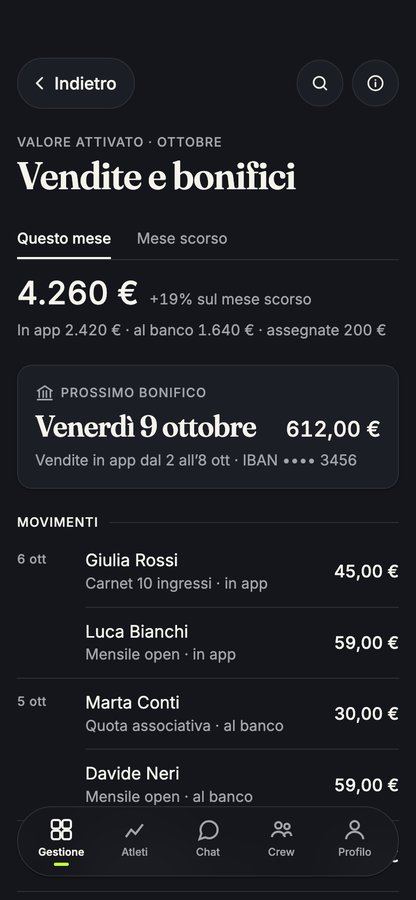
The model is public. Yeki earns from Plus and Yeki Pass, which people pay for, from a small service fee paid by whoever buys in the app, which you can choose to cover, from ads, and from apps with a gym's own brand. You receive the full price of your memberships. Members and memberships are imported from a file, and your business is ready in an afternoon.
- A class timetable with recurring classes, spots for every time slot and a waiting list that moves up on its own
- A cancellation window you set, the same at reception and in the app
- Memberships, class packs and drop-ins sold in the app, paid straight into your bank account, instalments included
- Outstanding balances and reminders in one tap, discount codes and gift cards
- A check-in QR code on every member's phone and in their Wallet, with turnstile integration
- Workout plans with exercise videos, chat, announcements, challenges and the members at risk of leaving